
Black Romance Bingo
A Black History Month Challenge for the Lovers and Letterboxd Listers

Since the beginning of the year, Black cinephiles have gathered online for “52 Weeks of Denzel,” a collective rewatch that treats Denzel Washington’s filmography as a living archive. It is also Black History Month, and with Valentine’s Day approaching, film once again becomes a way for the culture to think together. People are revisiting old favorites, debating legacies, and asking why certain stories continue to hold so much weight.
Looking back, December 2025 marked the 30th anniversary of Waiting to Exhale, a film that helped solidify what many now recognize as the modern Black romance canon. For me, the film was also a reminder that there aren’t many Black romance movies, and even fewer that depict Black queer love or that are told from men’s perspectives.
As a result, I decided to create a challenge.
This piece reintroduces my Black History Month and Valentine’s Day binge-watch bingo, built around twenty-five films from the Black romance canon. These films offer an opportunity to examine what keeps getting reproduced, which forms of love are centered, and which ones remain marginal or invisible.
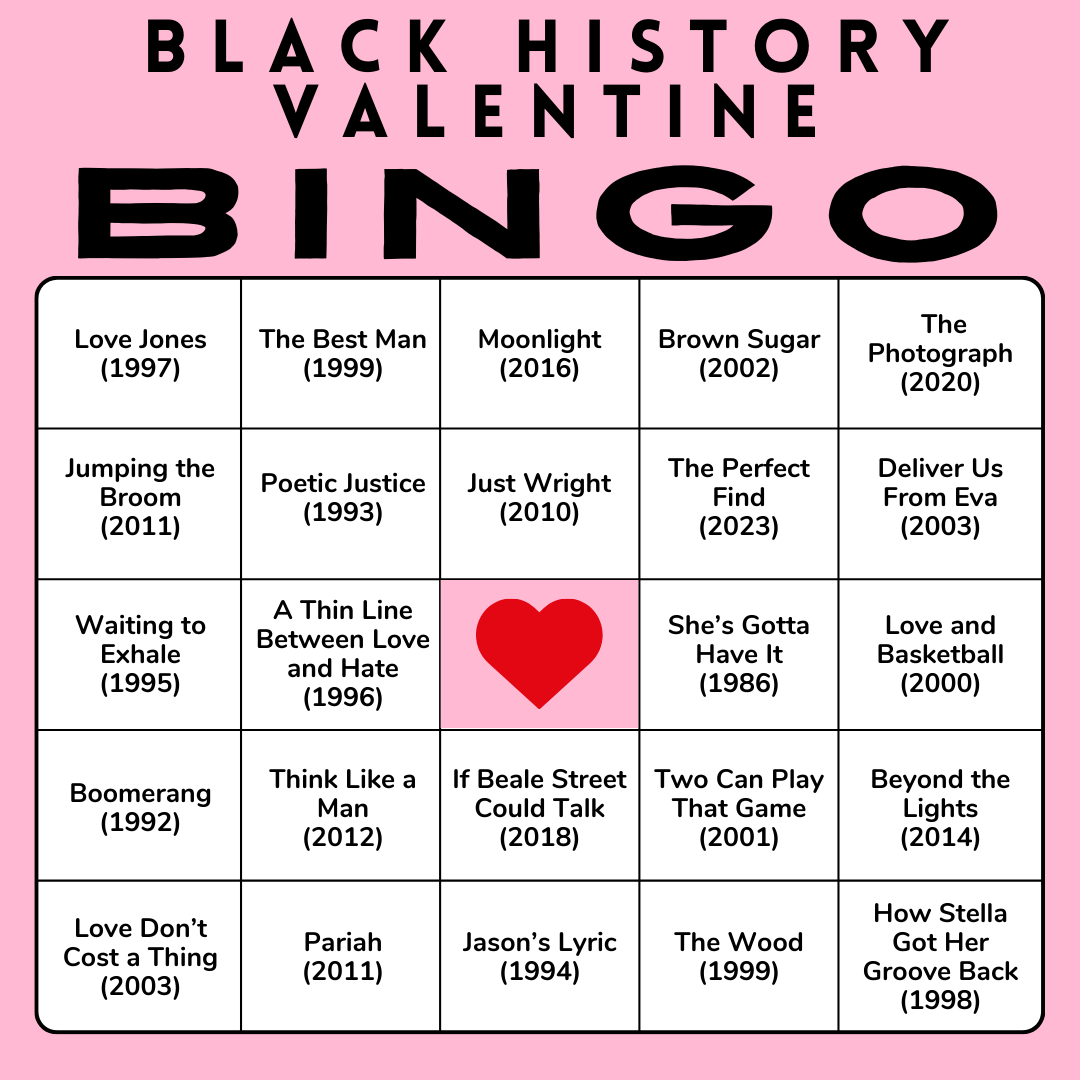
Consequently, what follows is both a guide and an invitation to watch closely and think critically about the romantic imaginaries Black cinema continues to circulate.
Defining Black Romance: Introducing the Selection Criteria and Honorable Mentions
But first, I would like to explain my definition of Black romance in films, how it informed my selection criteria, and why I excluded certain films from my list. For this challenge, I define Black romance as films in which the lead character or characters are Black and in a romantic relationship with another Black person. Furthermore, I have narrowed my selection to films produced during the digital filmmaking era (i.e., from the 1980s to the present) to make them easier to stream or download.
Based on the definition of Black romance films, a few movies are not included in this list. Before I proceed with the complete list of popular themes in Black romance, I would like to give honorable mentions to some of those films.
To begin with, some classic Black romance movies, such as Mahogany (1975) and Claudine (1974), premiered in the 1970s and earlier and do not meet the time criteria.
Moreover, several films focusing on interracial relationships, such as Loving (2016) or Hitch (2005), did not meet my criteria. However, I would like to give honorable mention to several movies that feature Sanaa Latham, such as Something New (2006), which tells the story of an interracial romance, and Nappily Ever After (2018), which explores the journey of self-love leading to romance.
While I focused on feature films, many interesting Black romance movies have been produced by cable channels such as Lifetime and BET, as well as independent producers and platforms. Finally, several films include romance but focus more on something else, so I left them off the list.
From Books to Buppys: On the Themes of Black Romance Cinema
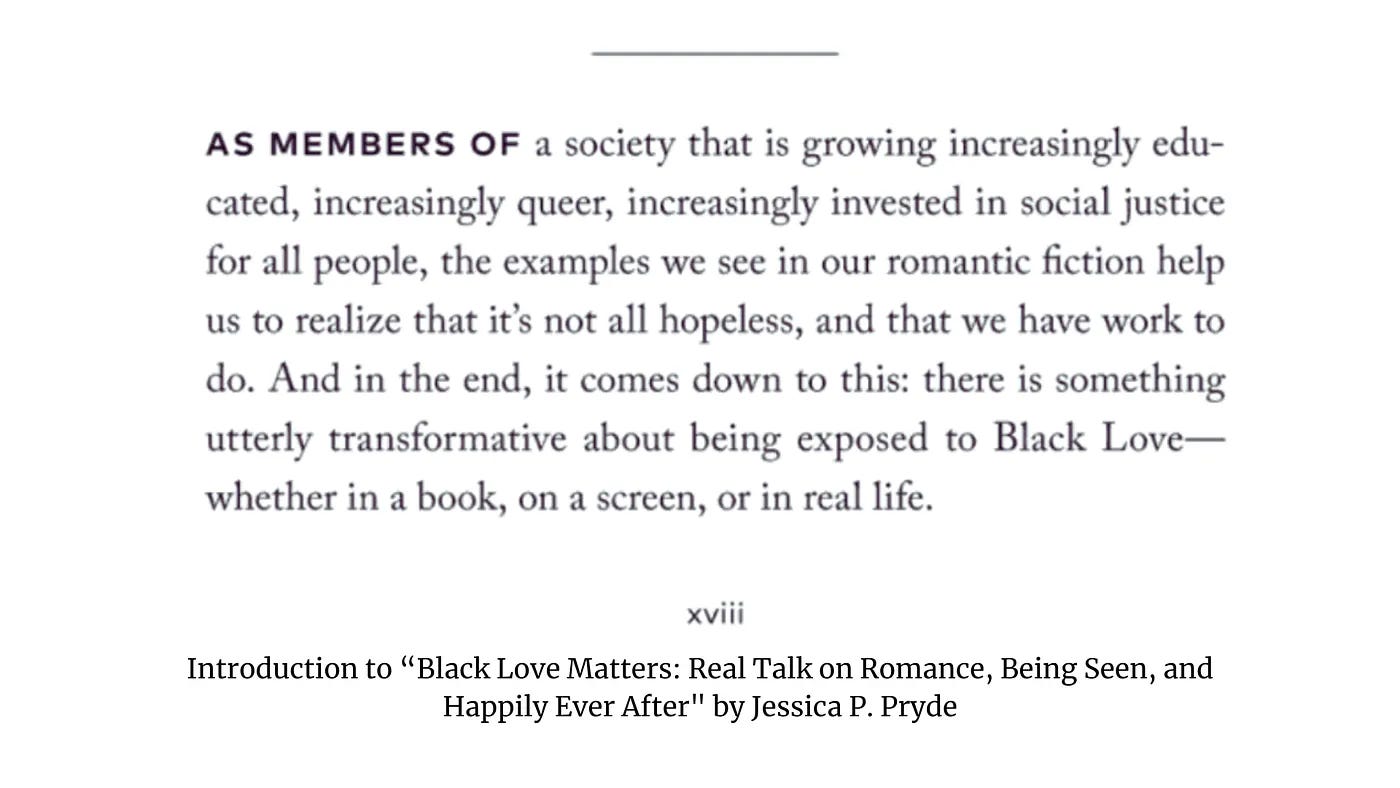
Before I started making my list of movies to include in my Black History Valentine’s Bingo, I had to look into how other film and media scholars defined the genre of Black Romance. The editors of the anthology “Black Love Matters: Real Talk on Romance, Being Seen, and Happily Ever After” highlight the growing popularity of Black romance fiction and the fact that many Black women are educated, book-loving readers. Platforms such as Oprah’s Book Club and Well-Read Black Girl showcase the importance of books in the lives of multiple generations of Black women.
As I researched Black romance films, I noticed that many of these films are based on books. Most notably, Terry McMillan, a famous author who has written many novels about Black women falling in love, has inspired several of the most popular Black films, from How Stella Got Her Groove Back (1998) to Waiting to Exhale (1995), and there is often a specific character type depicted in a McMillan novel.
These novels depict an educated and high-achieving Black woman who initially resists love but eventually falls for her persistent lover. And like the protagonists in Terry McMillan’s novels, I found that most Black romance films focus on the realities of upwardly mobile Black professionals.
For example, Professor Maryann Erigha argues in her article “Black Women Having It All: The Rise of Professional Women in African American Romance Films” that Black romance films signify a significant shift in portrayals, primarily due to social changes that led to an increase in Black women with advanced education and middle-class status. She also cites Mia Mask’s essay “Buppy Love in an Urban World,” where Mask coined the term “buppy love” to describe this romance genre. As a colloquial term, “Buppy” is similar to “Yuppy” and represents young Black professionals.
I noticed that many of the movies on my list fall under the “buppy love” category and feature characters under 30 who have achieved success in their careers and own homes, cars, and other symbols of wealth and status. Even when the movies portray financially struggling characters, they often have exciting backstories or advanced education. However, most characters facing financial difficulties are the typical “starving artist” trope rather than someone simply experiencing bad luck. And the most impoverished characters are usually sidekicks instead of leads.
Representing the oft-quoted phrase “no romance without finance,” the buppy love genre reflects one of the barriers to Black love within and outside of romance media. According to media scholar Rebecca Wanzo’s article “Black Love is Not a Fairytale,” media narratives about Black romance conflict with popular media discourse surrounding unmarried Black women.
In the early 2000s, national news organizations reported on the inability of professional Black women to find marriage partners, with multiple news networks and magazines asking the question, “Why can’t a successful Black woman find a man?”
Many times, these publications argue that Black women are “too successful” and will not be able to find counterparts who measure up to their achievements and social status. However, Wanzo argues that the primary issue with Black romance media is that it reflects a desire for a heteronormative fairytale of Black Love, which often excludes the realities of Black relationship struggles and the diversity of gender and sexual expression in romantic relationships. I also noticed the politics of desirability (e.g., colorism, beauty standards) in the casting of these films.
Introducing The Rules of Binge-Watch Bingo
After analyzing some of the essential themes in these movies, I would like to introduce you to my top 25. These films are not ranked in any particular order and do not include all of the movies I love in this genre. However, they provide an excellent overview. Like traditional bingo, you can watch the film in any order you prefer if you get four in a row (including the free space) before the end of February. If you haven’t seen any of the movies, you can start today and watch them all before the end of the month.
But I am sure most of you have seen many of these films, so you can complete the ones you have not yet seen to meet the challenge. While contemplating these films, I also realized that they mirror many of our discussions about romance and relationships in today’s society.
As I pondered over the discourse surrounding the idea of “high-value” individuals, it made me question whether these movies perpetuate stereotypes that are both racist and capitalist, promoting the notion that people have to prove their worthiness to earn love.
So, as you watch these films, you can also consider the following questions:
What types of propaganda or popular discourse exist in the Black romance genre?
Where are the queer people of color?
Who created the film, and who stars in it, i.e., actors, writers, producers, directors, etc?
How does this film oppose or reinforce heteronormative relationship ideals?
What role does money or success play in the characters’ lives and relationships?
Where do the characters live, and how does the location add to the cultural resonance of the characters and cinematography?
How does the film represent beauty and attractiveness, i.e., the politics or discourse around desirability?
Below, I also included a complete list of the 25 films I selected, along with their trailers. You can check them out to learn more about each movie. While watching the trailers, you can also reflect on the questions and observe how tropes and themes play out, even in the film summaries. And, I hope you enjoy this Binge-Watch Bingo challenge for Black History/Valentine’s Day!
The 25 Films Selected for Black History Month Valentine Bingo
1. Love Jones (1997)
2. The Best Man (1999)
3. Moonlight (2016)
4. Brown Sugar (2002)
5. She’s Gotta Have It (1986)
6. The Photograph (2020)
7. Jumping the Broom (2011)
8. Poetic Justice (1993)
9. Just Wright (2010)
10. The Perfect Find (2023)
11. Deliver Us From Eva (2003)
12. Waiting to Exhale (1995)
13. A Thin Line Between Love and Hate (1996)
14. Love and Basketball (2000)
15. Boomerang (1992)
16. If Beale Street Could Talk (2018)
17. Beyond the Lights (2014)
18. Think Like a Man (2012)
19. How Stella Got Her Groove Back (1998)
20. Jason’s Lyric (1994)
21. Pariah (2011)
23. The Wood (1999)
24. Two Can Play That Game (2001)
25. Love Don’t Cost a Thing (2003)